
Overall presentation
Recent approaches in conversational AI for social assistive robots primarily focus on a human-robot model, where the robot merely acts as a substitute for a human agent. In AnandaBot we propose to explore a human-(human/robot) approach, where the robot accompanies and complements the human agent.
Much like Ananda for his mentor, Buddha, the sidekick robot will enhance the abilities of its human counterpart and support the actions of its mentor in a triadic relationship with the user to address collaborative tasks. The aims of this approach are to:
- enhance human acceptance of a robot serving in a limited role as an assistant;
- promote research on the technical requirements for such interactions (in contrast to traditional « autonomous » systems): multi-party management, speakers’ input separation, dual conversation handling, and more.
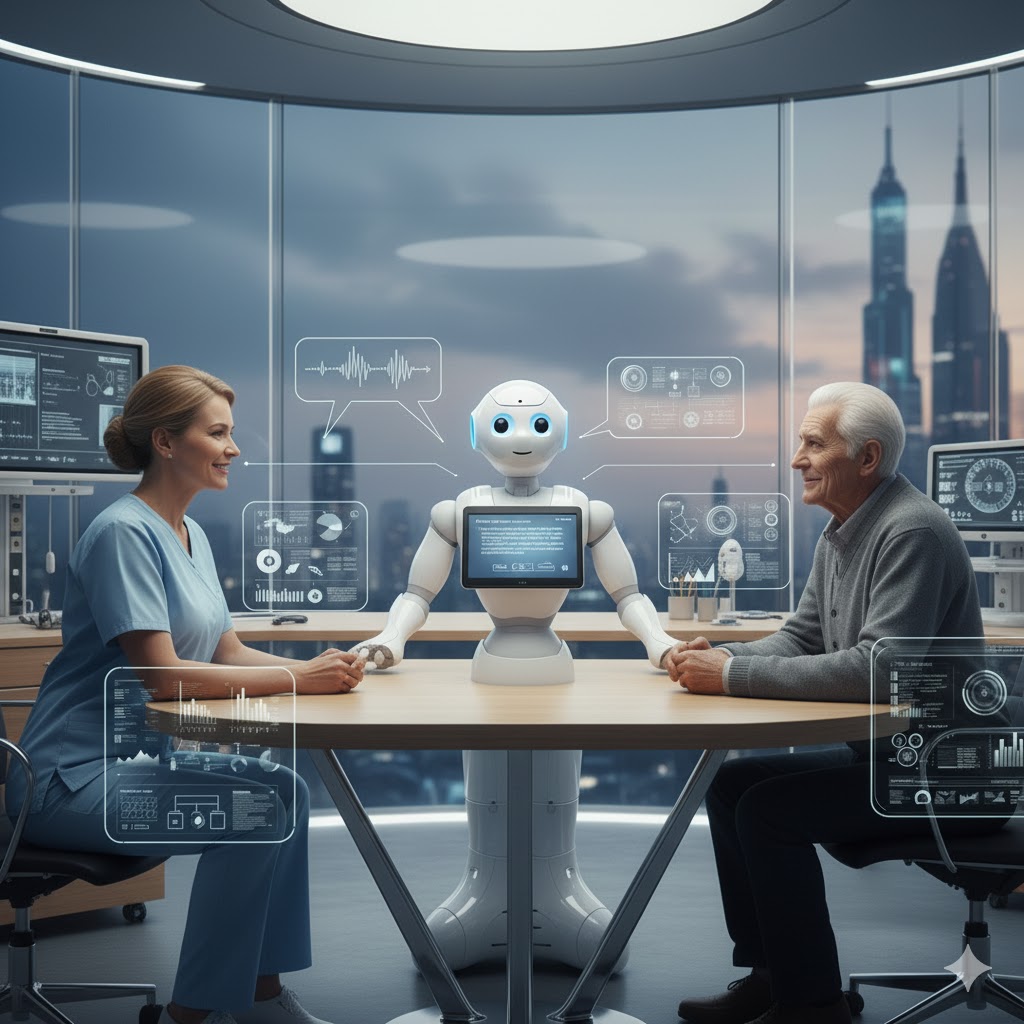
A robot placed in an assistant role will be in a vantage point to observe and learn from its mentor. This « internship » vision of the setup will eventually enable processes for progressively updating the interaction modules.
Application scenario
Within the study framework at AP-HP, the assistant robot is expected to support two types of personnel in a specialised gerontology healthcare service:
- psychologists — by helping facilitate cognitive assessment tests, positioning professionals as observers while the test occurs between the patient and the support robot;
- nurse aides — who can use the robot as a source of knowledge in their interactions with patients in the waiting room (appointments, delays, general information), including in a multilingual context.
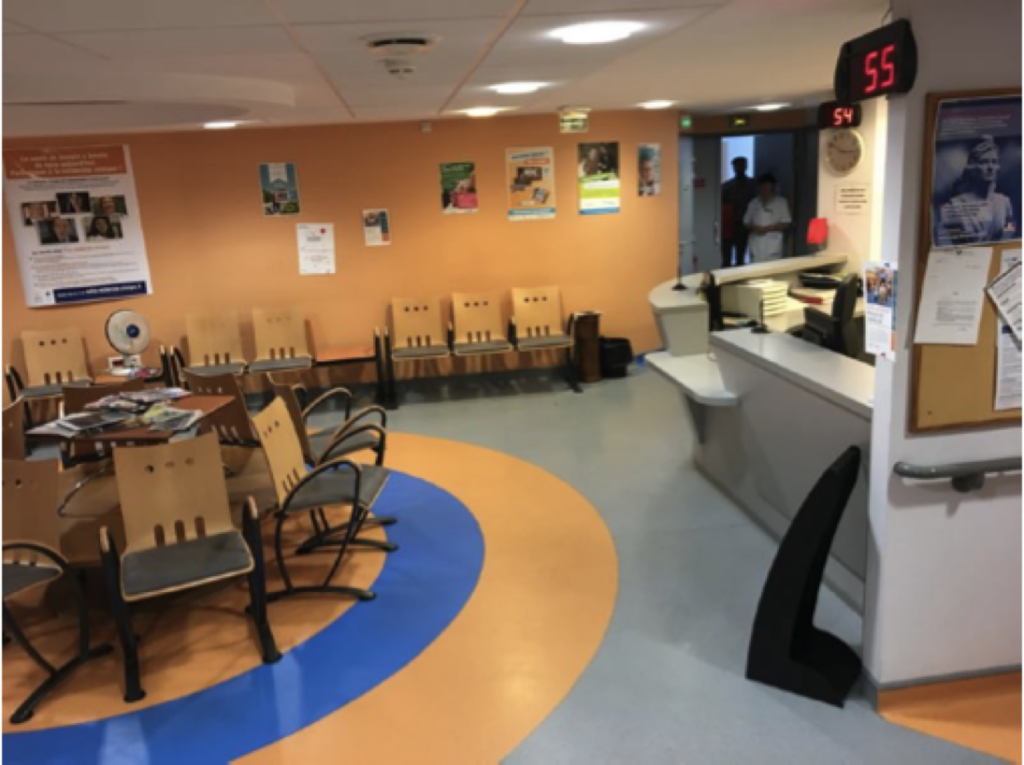
The proposed algorithms will be implemented on a general-purpose robot prototype and experimentally validated in one of the waiting rooms of the Broca Hospital (AP-HP). Usage scenarios will be developed for real-world testing, gradually increasing in complexity.
Ethics, privacy and sovereignty
A primary focus will be on developing local (on-premises) and low-resource solutions providing sovereignty and data-privacy protection for users. Cloud-based solutions for voice treatment will be avoided. Data recordings will include only volunteers who have given informed consent; personal data will be stored on a secure server with restricted access, and the detailed experimental protocol will be submitted for approval to the CNIL and the Ethics Committee associated with the Broca hospital.
Partners

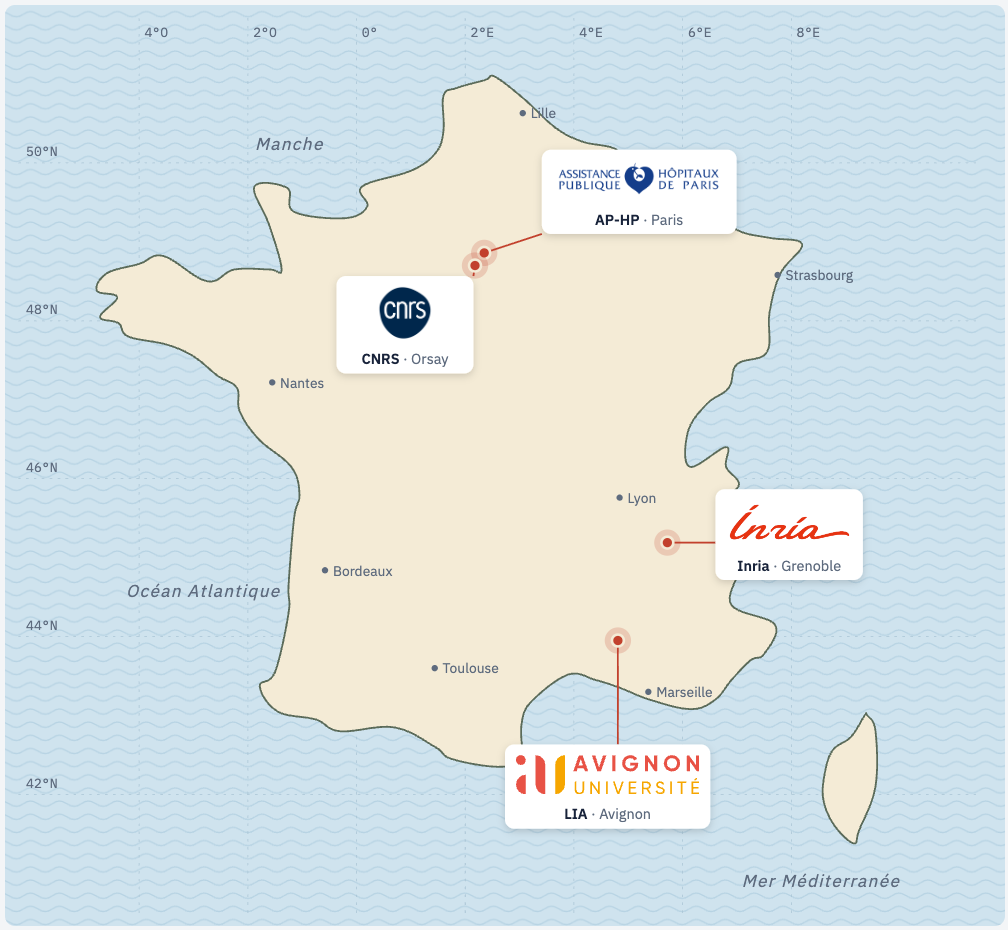
Avignon Université — Laboratoire d’Informatique d’Avignon (Coordinator)
Human-machine vocal interactions, dialogue management, decision-making learning, speech technologies (SpeechBrain).
lia.univ-avignon.fr
Avignon Université — Laboratoire d’Informatique d’Avignon (Coordinator)
Human-machine vocal interactions, dialogue management, decision-making learning, speech technologies (SpeechBrain).
lia.univ-avignon.fr

INRIA — RobotLearn Team, Inria Grenoble Rhône-Alpes
Audiovisual perception, machine learning for social robotics, continual learning.
team.inria.fr/robotlearn
INRIA — RobotLearn Team, Inria Grenoble Rhône-Alpes
Audiovisual perception, machine learning for social robotics, continual learning.
team.inria.fr/robotlearn

CNRS / Université Paris-Saclay — Laboratoire Interdisciplinaire des Sciences du Numérique
Speech emotion recognition, affective computing, ethics of human-machine interaction (AI Chair HUMAAINE).
lisn.upsaclay.fr
CNRS / Université Paris-Saclay — Laboratoire Interdisciplinaire des Sciences du Numérique
Speech emotion recognition, affective computing, ethics of human-machine interaction (AI Chair HUMAAINE).
lisn.upsaclay.fr

Assistance Publique – Hôpitaux de Paris — Broca Hospital, Lusage Living Lab
Healthcare application in gerontology, experiments with older adults and health professionals, psychological survey.
lusage.org
Assistance Publique – Hôpitaux de Paris — Broca Hospital, Lusage Living Lab
Healthcare application in gerontology, experiments with older adults and health professionals, psychological survey.
lusage.org
Key persons

INRIA RobotLearn
Research Scientist, team leader, audiovisual perception (site coordinator)
LISN, CNRS/Univ. Paris-Saclay
Professor, affective computing (site coordinator)

LIA, Avignon Université
Professor, speech technologies

AP-HP
MSc in Experimental Cognitive Psychology, researcher at Broca Living Lab

LIA, Avignon Université
Professor, PI & Scientific Coordinator, dialog modelling

LIA, Avignon Université
Professor, speech recognition & understanding

INRIA
Senior Research Scientist, continual learning

AP-HP
PhD in Cognitive Ergonomics, Director of Broca hospital’s lab
AP-HP
Professor, Head of the Geriatric & Research Department, Broca Hospital (site coordinator)
The permanent staff will be joined by PhD students, post-docs and research engineers recruited by each partner.
Organization
To address the overall objective of AnandaBot — a human-(human/robot) approach where the robot accompanies and complements the human agent — the project will develop an advanced perception-(pro)action processing chain enabling voice exchanges between robots and humans to carry out a triadic collaborative task. The strategy hinges on two subsidiary scientific objectives:
- enable autonomous interactions between (humanoid) robotic platforms, mimicking situations of interest, to allow simulation-based training and evaluation;
- develop on-site solutions for all modules to enhance users’ privacy.
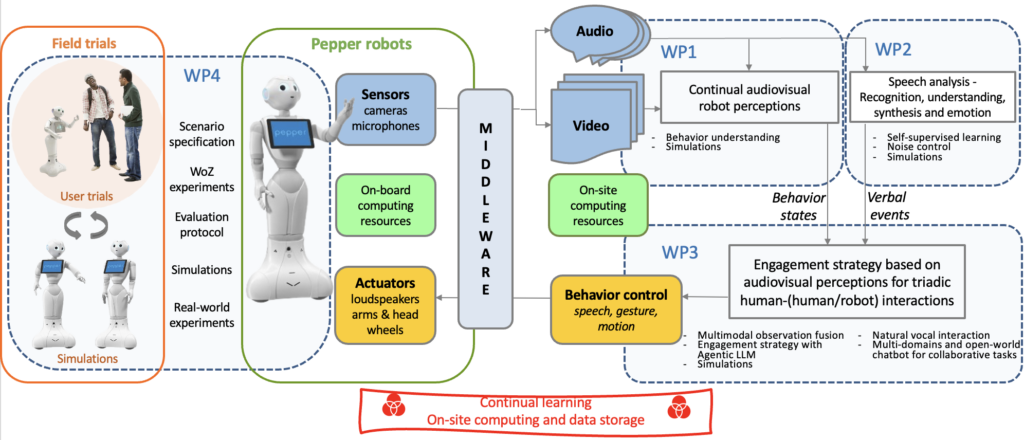
The work programme is broken down into five work packages: