
Motivations
In order to alleviate human activities, many tasks are being transferred to automated solutions based on conversational AI. However, for collaborative tasks requiring verbal interaction, replacing humans with fully automated solutions has shown its limitations: limited social skills, poor adaptation to real environments.
AnandaBot sits at the intersection of human-robot interaction and human augmentation by proposing to study a new interaction paradigm for human-(human/robot) collaboration: the aim is to relieve and assist human activities by providing humans with an engaging, motivating, and dutiful sidekick — such as Ananda for Buddha!
Ambitions
AnandaBot will develop the multimodal processing chain for triadic verbal interactions between a user, a human agent, and their robot sidekick. The main functions adapted to this new paradigm, which structure the work programme, are:
- audiovisual scene analysis;
- speech recognition and understanding;
- simulation and detection of emotions in robotic interaction;
- dialogue management and decision-making processes.
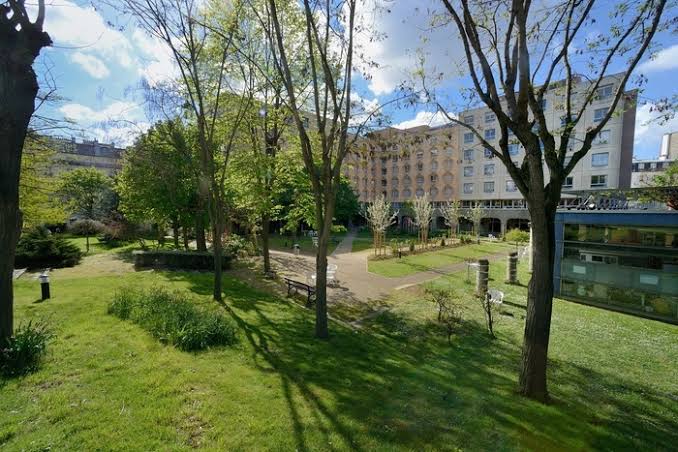
The work will be carried out mainly in French. The experimental framework, in which AnandaBot research will be iteratively evaluated, is that of a day-care hospital in a gerontology ward, enabling collaboration with elderly people in solving specific tasks — involving psychologists (cognitive tests) and nursing assistants (patient assistance, translation).
Autonomous simulation for continual learning. AnandaBot will develop an autonomous physical robotics solution based on simulators that replace humans, enabling continuous learning of the modules while reducing the cost and complexity of training and evaluation before deployment in real settings with human partners.
Local & sovereign by design. AnandaBot prioritises local, on-premises and low-resource solutions for each module, for ethical uses that respect privacy — data-efficient approaches deployable on standard computer hardware, increasing the impact of the project’s results.
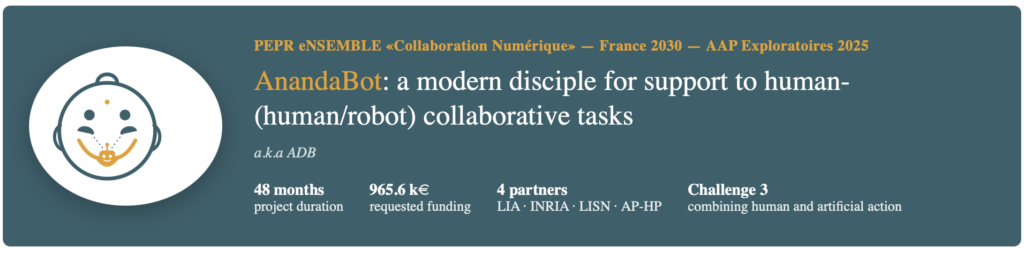
The project is funded by the PEPR eNSEMBLE «Collaboration Numérique» (France 2030), Appel à Projets Exploratoires 2025 — Challenge 3: Combining human and artificial action in collaborative configurations.